Eight teams, eight rounds, one market
A Komrce case study: Marketing Summer School 2026, ASE Bucharest
Summary
Eight student teams ran eight virtual online stores on the same simulated market, for eight rounds, at Marketing Summer School 2026, the summer school of the Faculty of Marketing at ASE Bucharest. All eight started learning in round one, and the lesson was paid in money: every team closed it at a loss.
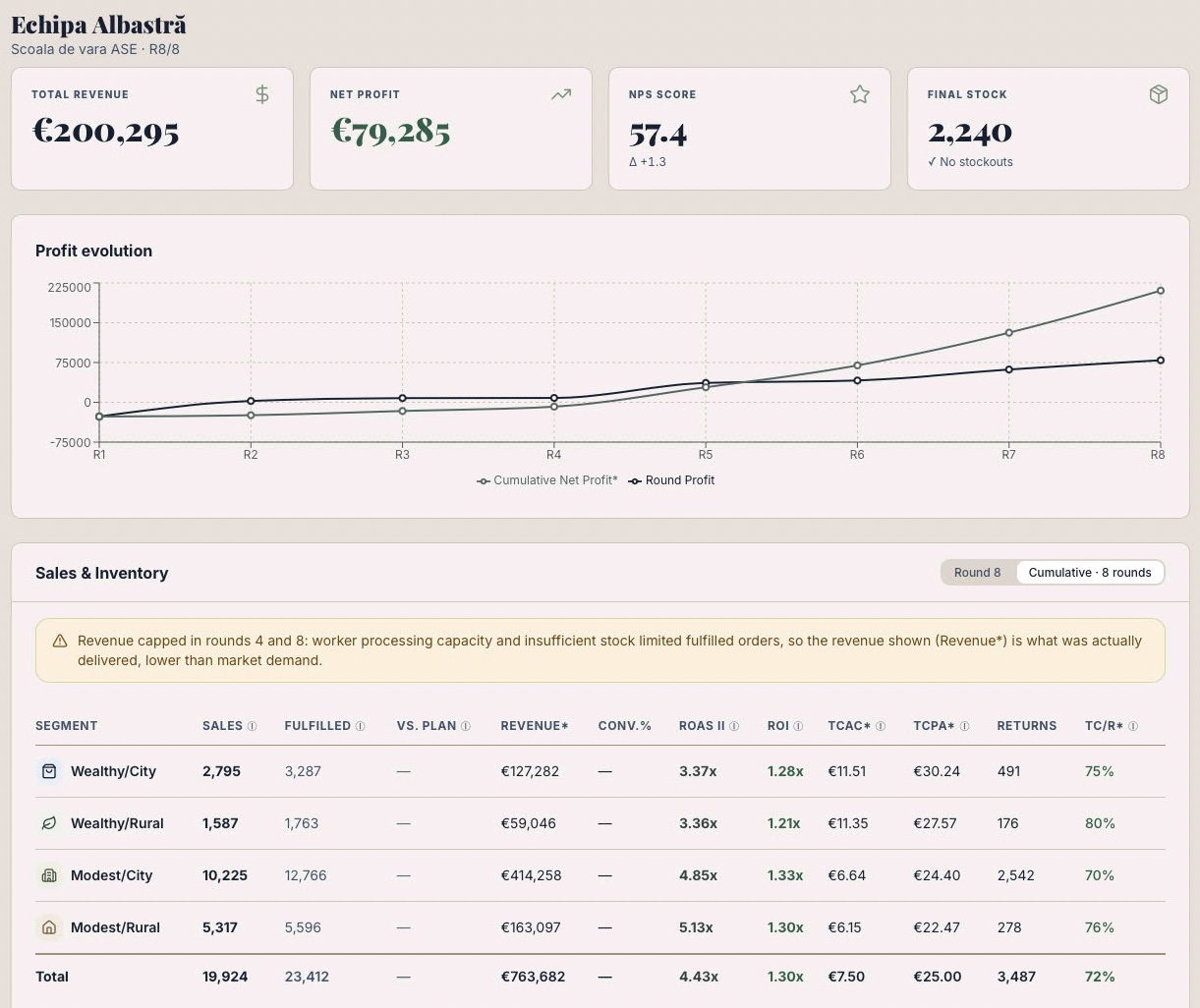
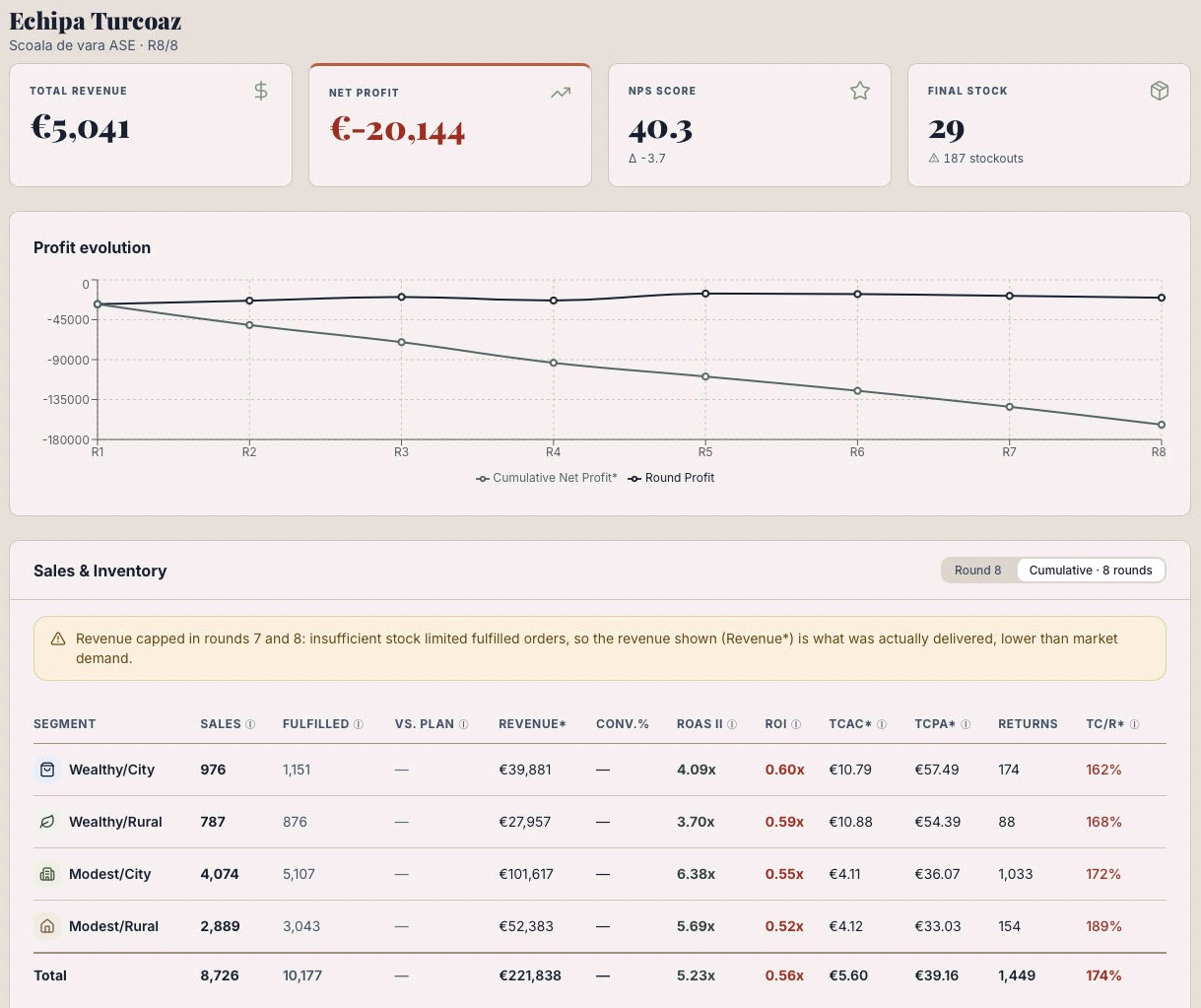
By the end, the gap between first and last place was almost €374,000: the Blue team finished with +€210,597 in cumulative profit, the Turquoise team closed at -€163,311, and five teams out of eight ended in the red.
The difference came neither from luck nor from budget: everyone started with the same inherited structure and the same default values. It came from round 2, when a single team seemed to understand what the round-one loss was telling them. The rest understood later, and some never did.
And what that team understood was not a pricing trick or an ad-budget trick: the whole profit and loss statement had to be fixed at once, from people and stock to the marketing mix.
What you will find in this study: what the same mistakes look like in real business, and what you can take from each one for your own.
The context and rules of the komrce.eu world
In this business simulation, each team runs an online store selling to four customer segments (city and rural, each in a premium and a standard variant). Round after round, the team decides prices per segment, ad budget, brand investment, inventory orders, packaging, hiring, layoffs and wages.
The market is shared and alive: the average price your competitors sell at changes your results, and the customer one team loses is won by another.
Important for what follows: every store starts with an inherited structure, 5 workers and 2 support people, starting stock in the warehouse, and the first-round decisions come pre-filled with default values that any team can change entirely. The defaults are designed to lose money. The first lesson of the game is exactly that: an inherited plan is not a plan.
Marketing Summer School 2026 (July 28 - August 2) is the summer school of the Faculty of Marketing at ASE Bucharest, organized together with the AMA student association, under the theme "Human. Helpful. Findable.": the new rules of marketing, from creativity and advertising to being found in AI-mediated search.
The program packs six days of hands-on workshops and masterclasses: field research in Brașov, 1:1 mentoring and final project presentations with awards. Day three, July 30, was entirely the business simulator day: the eight rounds in this study, played by eight student teams and facilitated by Ionuț Radu Munteanu, founder of Komrce.
The anatomy of the round-one loss
Round 1 was the universal shock: eight losses, between -€19,116 and -€31,641. Not because the teams played identically: almost all of them tinkered with something, a price moved by €1-5, budgets shuffled between segments, a hire here, a layoff there.
Small differences in decisions explain the small differences in results: the Red team laid off two people from the start and lost the least; the Orange team hired two and lost the most.
A detail worth remembering: the Blue team, the future winner, changed exactly one thing in round 1: it pointed the premium urban ads entirely at new customers. Every other value it closed the round with was the default.
But the shared loss has a different explanation: no team closed the big taps, all four open at once:
- Too many people for the volume sold: 7 full salaries for a store that had barely started.
- New stock ordered on top of unsold stock: seven teams out of eight let the default €15,000 order go through, and the eighth trimmed it by just €650, although everyone already had goods in the warehouse.
- Too little marketing to move sales: a token ad budget, spread thin across four segments.
- Prices set below what the premium segments would have paid.
Micro-optimizing while the structure is bleeding does not show up in the standings. The real difference was made from round 2 onward: how many of the four taps each team closed, and how fast.
The market, round by round
From round 2, the paths split, and the overall trend is clear: the market got more expensive.
The average price on the premium urban segment climbed steadily, from €34 in round 1 to €48.5 in round 8, as teams discovered that a price too low on a segment willing to pay means money left on the table.
At the opposite end, the standard rural segment remained a discount trench for the whole game, with averages of €24-27, where margin is hard won.
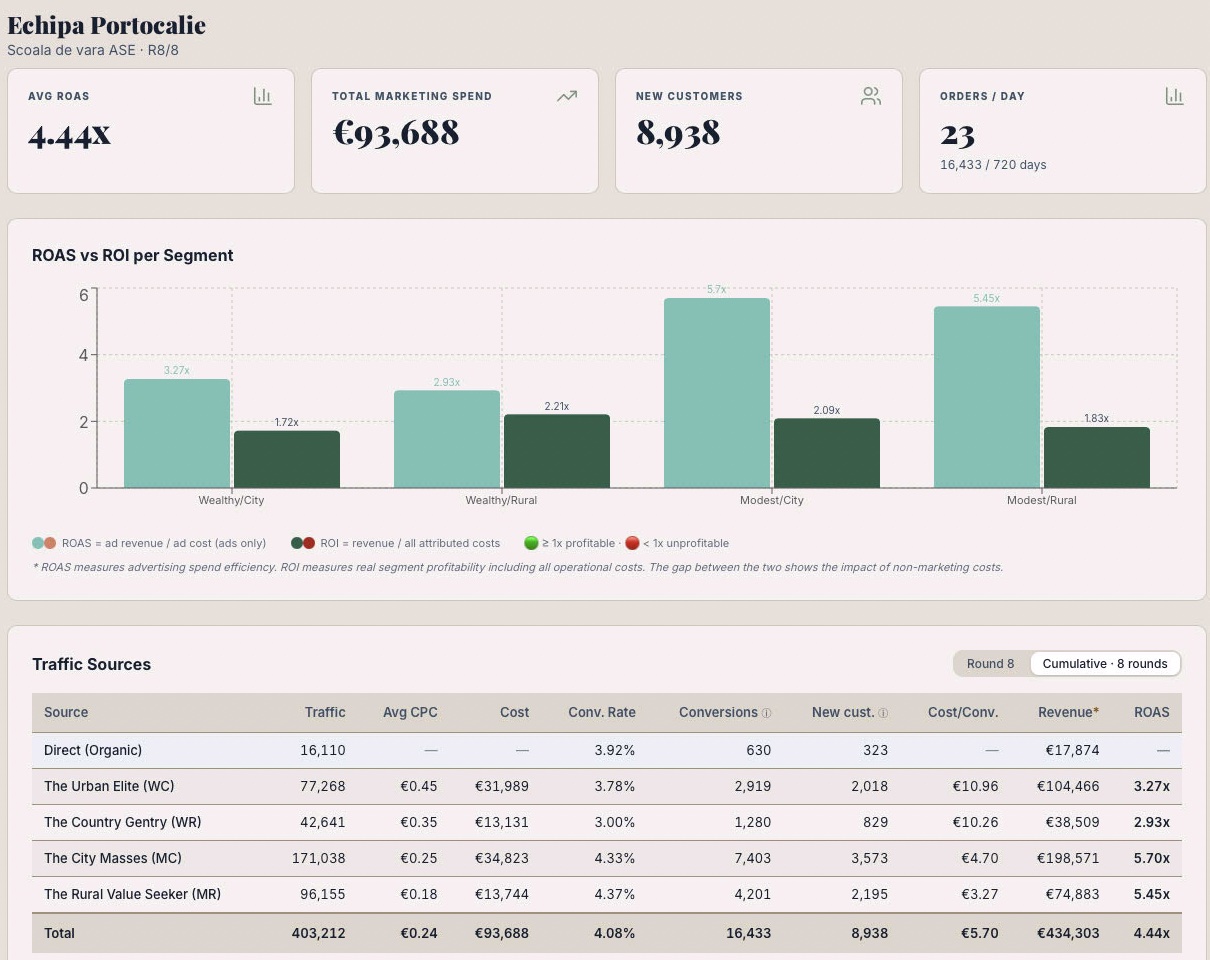
The second trend: the advertising arms race. Performance budgets started from the default €5,000 and reached, at the leading teams, €50,000 and €70,000 per round by the end. Whoever stayed at token budgets stayed, quite literally, unseen by customers.
Three roads through the same market
The Blue team, the winner, fixed the whole P&L at once. Its round-2 pivot is usually quoted for the ads, but it had four simultaneous pieces: it tripled the performance budget (€5,000 to €15,000), rebalanced the brand money (from 20% to 10%, without giving it up), stopped stock orders until the inherited goods sold, and cut into the staff structure.
It was the only team in the black in round 2, with a modest +€2,500 profit, while everyone else was still losing.
From there, it raised prices step by step, round after round (36, 40, up to €60 on premium urban), reordered stock only when demand justified it and, once profit allowed, raised the wages of those who remained.
It had a single stockout episode in the whole game, 294 unfilled orders in round 4, and the lead taken in round 2 was never given up in any round.
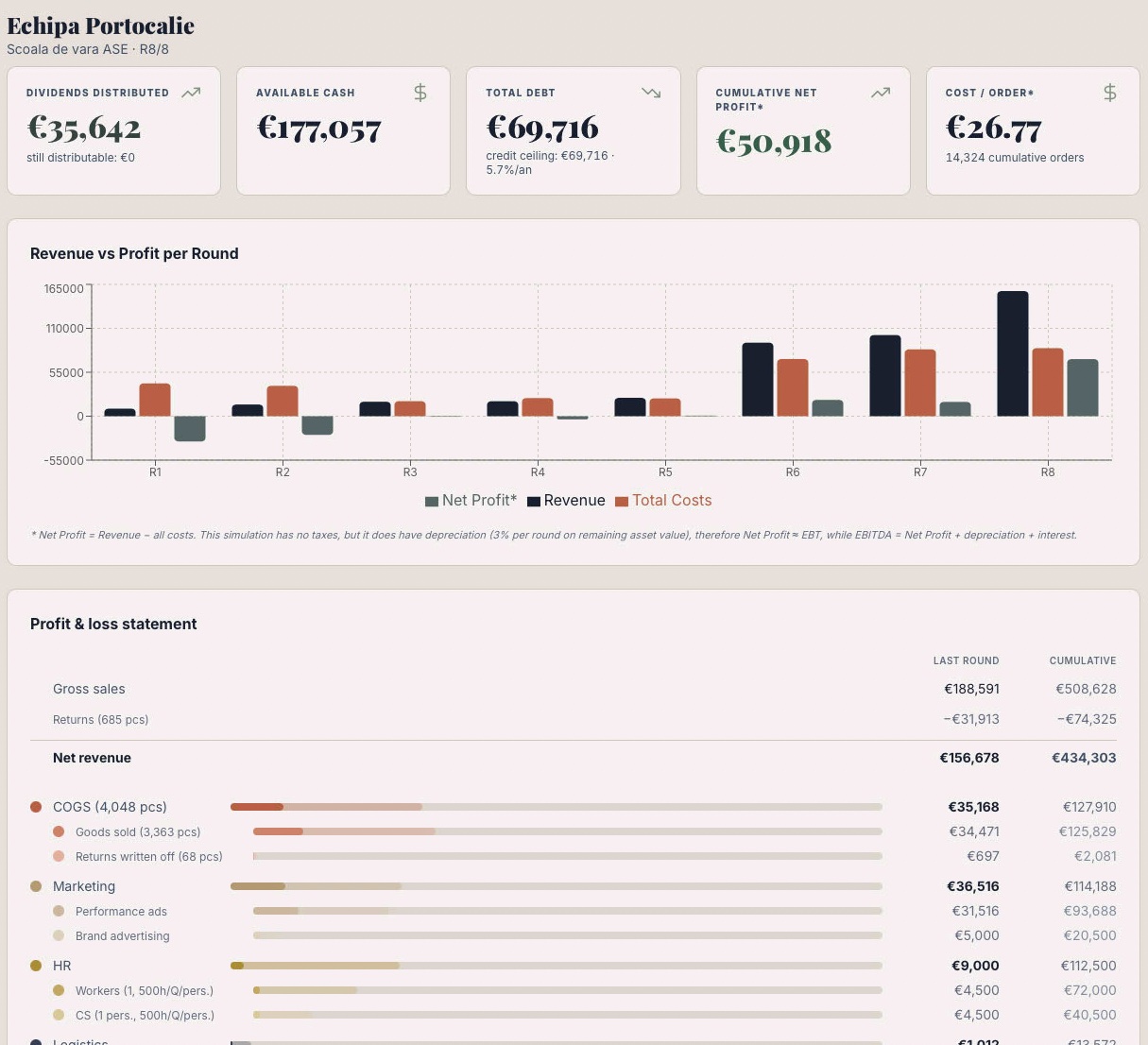
The Orange team proved you can come back even from the bottom of the pit. After four rounds of premium prices with minimal ads, the "expensive store nobody sees" formula, it sat at -€60,000, even though it had cut staff drastically back in round 3, six people in one move, after actually hiring in round 1.
The round-6 pivot was brutal: the ad budget multiplied by ten, from €5,000 to €50,000, brand reduced, a large inventory order.
Profit erupted immediately: +€20,000, +€18,000, then +€71,000 in the final round. It paid its first growth lesson along the way: in round 7, the demand stirred up by the ads outran the stock and 1,063 orders went unfilled.
From -€60,000 to +€51,000 in three rounds: the most spectacular arc of the cohort.
The Red team, the round-one leader, fixed a single line, and the wrong one. It was losing the least of all (-€19,116), and deservedly so: the only big move of round 1 had been theirs, two salaries cut. But it read the result as a confirmation of the direction, not as a warning that the rest of the structure was still bleeding.
In round 2 it raised every price and ordered another €15,000 of stock, at a loss, on top of goods already unsold. In round 3 it pushed premium urban to €49, €11 above the market average, raised brand to 40% and left the ads at the default value.
On staffing it wobbled: it hired people back in round 3 only to lay off four in round 4.
The result: the same €14-15,000 losses round after round, a falling NPS and a final 5th place at -€75,442. The same information as the Blue team, in the same round, read upside down.
The turning point
Round 2 is the hinge of the whole simulation, not because everything was decided there, but because that is where the difference in method showed. Two teams looked at the same red numbers from round 1 and drew opposite conclusions.
The Blue team treated the loss as a system diagnosis: it closed all the taps at once, people, stock, the marketing mix, and let the price climb gradually as the rest settled.
The Red team treated it as a pricing problem: we are not covering our costs, so we raise prices. Except that raising prices without an audience does not grow revenue; it hands it to the competition.
From that point on, the two trajectories never crossed again: one climbed eight rounds in a row, the other declined eight rounds in a row.
The rest of the pack, briefly
The other roads complete the map of possible mistakes, each on a different lever left unattended.
The Yellow team did marketing without operations: premium packaging, brand at 40%, €30,000 of ads per round, but zero or token inventory orders and, for one round, wages pushed to €1 per hour, below the threshold where employees start leaving. Expensively bought demand hit an empty shelf: 2,658 stockouts, the cohort's negative record.
The Purple team bought love without margin: the best NPS in the game (61.5), premium packaging and generous brand, but -€61,823 at the end and wages kept below the threshold for rounds on end. A happy customer is not the same thing as a healthy business.
The Green team showed that indecision is also a decision: ad budgets between €500 and €3,000 per round, always below the default, prices ending in .99 below the market average, zero stock orders seven rounds in a row. Debt grew monotonically to €55,000, and its NPS ended up last (39.6).
The Turquoise team, last place, is the most instructive case precisely through absence: it did not touch the staff structure or wages for seven rounds out of eight. The same 5 workers and 2 support people, at the same wage, no matter what sales were saying. The record loss, -€163,311, did not come from a bad decision, but from the refusal to make any.
And the Pink team was the opposite of everyone: it right-sized its staff early, reordered stock only late and justified, zero stockouts in the whole game, slow growth and a finish at +€34,100, with the second-best NPS in the standings. Prudence did not win the race, but it finished on the podium, without scars.
A note about the endgame: in the final round, several leading teams took out loans to pay large dividends and cut the spending that no longer had time to produce effects. It is end-of-quarter behavior, seen in real companies too.
How many decisions the teams changed, round by round
One last layer of the analysis: the volume of changes. For each team we counted how many settings in a round's final decision set differ from the previous round: prices, forecasts, ad budgets, brand, packaging, wages, the stock order.
| Team | R2 | R3 | R4 | R5 | R6 | R7 | R8 | Total | Final place |
|---|---|---|---|---|---|---|---|---|---|
| Blue | 15 | 11 | 12 | 13 | 9 | 9 | 17 | 86 | 1 |
| Orange | 16 | 11 | 17 | 9 | 8 | 7 | 20 | 88 | 2 |
| Pink | 10 | 11 | 13 | 17 | 23 | 12 | 23 | 109 | 3 |
| Purple | 15 | 13 | 17 | 17 | 13 | 15 | 11 | 101 | 4 |
| Red | 24 | 12 | 12 | 13 | 9 | 20 | 12 | 102 | 5 |
| Yellow | 19 | 2 | 6 | 1 | 3 | 3 | 6 | 40 | 6 |
| Green | 22 | 14 | 16 | 11 | 17 | 17 | 22 | 119 | 7 |
| Turquoise | 18 | 15 | 16 | 16 | 12 | 12 | 13 | 102 | 8 |
First observation: the volume of changes does not predict the standings. The Green team changed the most in the whole pack (119 settings) and finished 7th; the winner changed less than the group average. What you change matters, not how much.
Second: the Yellow team moved massively in round 2 (19 changes), then went numb for five rounds in a row, at 1-6 changes per round, while losing money constantly. And the Turquoise team adjusted settings every round, so it was present in the game; only the structural decisions were missing entirely.
The outcome
| Place | Team | Cumulative profit | Final NPS | Stockouts |
|---|---|---|---|---|
| 1 | Blue | +€210,597 | 57.4 | 294 |
| 2 | Orange | +€50,918 | 56.9 | 1,063 |
| 3 | Pink | +€34,100 | 60.5 | 0 |
| 4 | Purple | -€61,823 | 61.5 | 0 |
| 5 | Red | -€75,442 | 48.6 | 0 |
| 6 | Yellow | -€94,533 | 55.5 | 2,658 |
| 7 | Green | -€112,512 | 39.6 | 0 |
| 8 | Turquoise | -€163,311 | 40.3 | 339 |
What stays with you
All the teams got the same start, the same market and the same information. The final standings do not measure who worked harder, but who read the market's feedback more accurately and how many levers they acted on.
In real business, that message arrives as negative cash flow in year one. The reactions seen here, the full restructuring, the single-line correction and the freeze, exist there too, with the same endings.
If you remember six things from this study:
- An inherited plan is not a plan. The cost structure you have not questioned yourself, people, stock, budgets, is already a decision, usually a bad one.
- A loss is a diagnosis, not an injustice. Look for all the open taps, not just the most visible one.
- There is no turnaround on a single budget line. People, stock, marketing and price get fixed together.
- Price fixes the margin, not the lack of customers. If nobody sees you, the problem is not the price.
- Do not buy demand you cannot deliver. The ad budget and the stock order are one decision.
- Brand is not your enemy, but it will not save you alone. The winner kept brand running the whole game, at 10-20%, next to channels that brought measurable customers. The teams that pushed brand to 40% without performance paid dearly for the difference.
And one last idea, with a gram of stoicism: in the simulation, as in business, the market owes you nothing and you do not control it. You only control the next decision. The teams that finished well were not the ones spared by crises, but the ones that treated every bad round as information, not as an injustice.