
You run an online store. You learn what happens when you get it wrong.
Komrce is a simulation where you make the decisions of a real business, price, marketing, stock, people, delivery, and the market answers. It is not a course about eCommerce. It is eCommerce, with real consequences and no invoices.
No card. All you need is an email and ten minutes.
Decisions today. Advantage tomorrow.
You decide
Price on 4 customer segments, marketing budget, stock, people.
The market answers
Sales, share, NPS, cash. Not what you hoped, what you got.
You see why
The market report shows what the others did.
Two rounds, against two stores run differently
You captain your own store. Two simulated businesses with opposite strategies enter the same market: one buys market share with money, keeps all its staff and postpones profit. The other cuts costs from round one and pays a steady dividend. You play at your own pace; the round closes when you submit.
Start the demoThe first step is a username and a password. Then you are in the game.
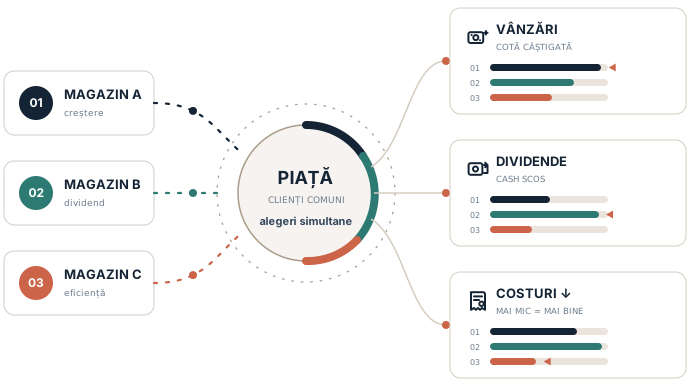
What you will learn to decide as an entrepreneur
Each round you run one quarter of the company’s life. If you have ever played a turn-based strategy game, you already know the rhythm: every team decides, the round closes, the market answers everyone at once. You form hypotheses, allocate limited resources and measure the effects on demand, margin, cash and value created.
Pricing
per segmentOne price for each of the 4 customer segments, plus your sales estimate. Ads never buy beyond your forecast.
You will learn to estimate price sensitivity and balance volume against contribution margin.
A price is not a number, it is a position: it brings you volume in one segment and pushes you out of another.
Marketing
per segmentHow much you allocate, how you split it between segments and how much goes into brand instead of direct sales.
You will learn to split the budget between acquisition, remarketing and brand, weighing CAC, ROAS and cash together.
Ads pay off now, brand pays off rounds later. Both come out of the same budget.
Promotions
whole companyA discount campaign, on or off. It lifts conversion, but not equally across segments.
You will learn to compute whether the incremental volume covers the sacrificed margin.
You buy conversion from people who were watching the price anyway. Ask who you are paying, not just how much you sold.
Inventory
whole companyHow much stock you order now. It arrives next round, so you order for who you will be, not who you are.
You will learn to turn the forecast into a supply plan, with lead time, locked capital and stockout risk.
A stockout is not just the lost sale, it is the customer who makes your next customer more expensive.
Packaging
whole companyBasic, standard or premium, one choice for the whole company. Each step lifts conversion a little.
You will learn to compare the marginal conversion benefit with the cost per order.
Nothing that is free for the customer is free for you.
Delivery
per segmentPaid by the customer, standard or express, chosen separately per segment.
You will learn to match the service level to each segment’s willingness to pay.
Some pay for speed, others stop exactly at the shipping cost.
People and money
whole companyHiring, layoffs, wages, credit and how much profit you distribute as dividend.
You will learn to size capacity, tie wages to productivity and choose between reinvesting and paying out.
People are capacity, not budget: orders beyond what the team can process are lost.
The rules of the world in Komrce simulations
How the market moves, how the customers move and how the money moves. The same rules for every team, in every session.
Public page: no account, no email.
The application screens
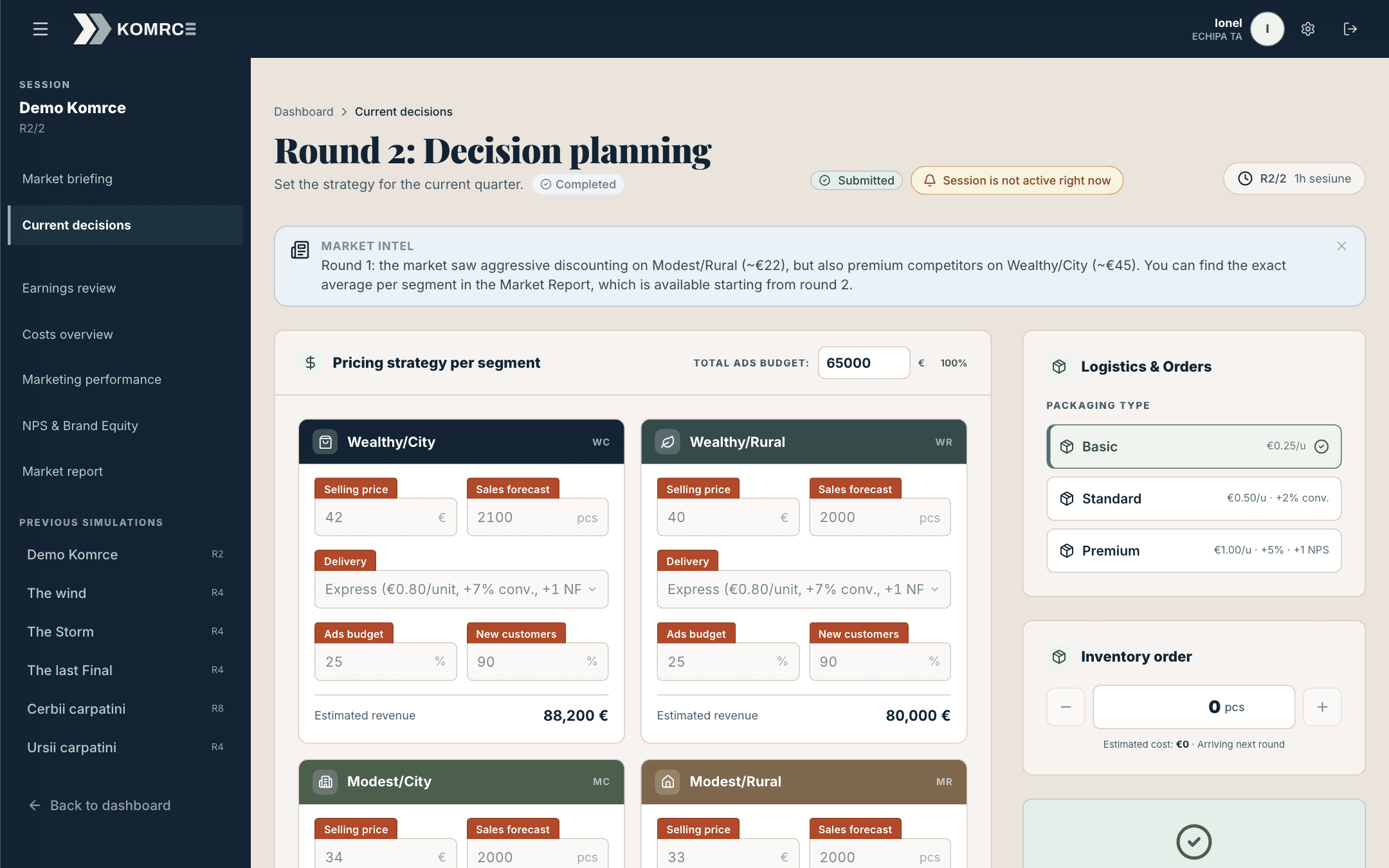
What you leave with
Not with a certificate and not with eCommerce theory. With four things you can do on Monday morning, on your company or your employer’s.
You choose who you serve
4 customer segments with opposing behaviours. You leave with the reflex "who is this price for", not "is this price good".
You tell a cost from an investment
Ads pay off today, brand pays off three rounds later. You have also seen what not investing costs.
You size for demand, not for fear
You know what you lose when the team is smaller than the sales, and what it costs when it is bigger than needed.
You decide before the deadline
The most common cause of a lost round is not a wrong decision, it is a debate that never ended.
Business is learned by making decisions, not by hearing about them
Theory explains what should work. The simulation shows you what happened when you tried. The difference between play and learning is the debrief: what you decided, what the market did, what you would do differently.
Reputation is not a choice
It has no button, it is the consequence of your other decisions. A stockout or a badly served customer inflates your returns, chases away the customers who were coming back and makes your credit more expensive, all at once.
The click has no fixed price
All teams bid on the same demand pool. While it fits, everyone gets what they paid for. When pressure rises, the cost per click climbs in steps for everyone, you included.
The score is the dividend
Not revenue, not company size. What counts is the money you took out of the company. You can build the prettiest business in the market and lose to a smaller one that knew when to distribute profit.
Why it is worth a day in your team’s calendar
In a real company, a bad pricing or stock decision shows up a quarter later and gets paid for out of margin. In Komrce it shows up after one round and gets paid for in points. In a single day, the team goes through several quarters of decisions and sees where they lead, with no real money on the line.
And it goes through them together. Marketing learns what a delivery promise costs, operations sees why the ad was paid for, whoever holds the money understands why the team kept asking for stock. Disagreement gets resolved before the deadline, not hidden behind a vote.
This is what your team keeps: a decision model you can use tomorrow, and a language in which marketing, operations and finance are no longer three different tongues.
See it in practice: the case studies, with the decisions and numbers on the table →
A private cohort for your team
Companies, universities, internal programs. A dedicated session, a date chosen together, a Komrce facilitator and invoicing on the organization.
Are you a trainer who wants to deliver Komrce programs? Leave your details